
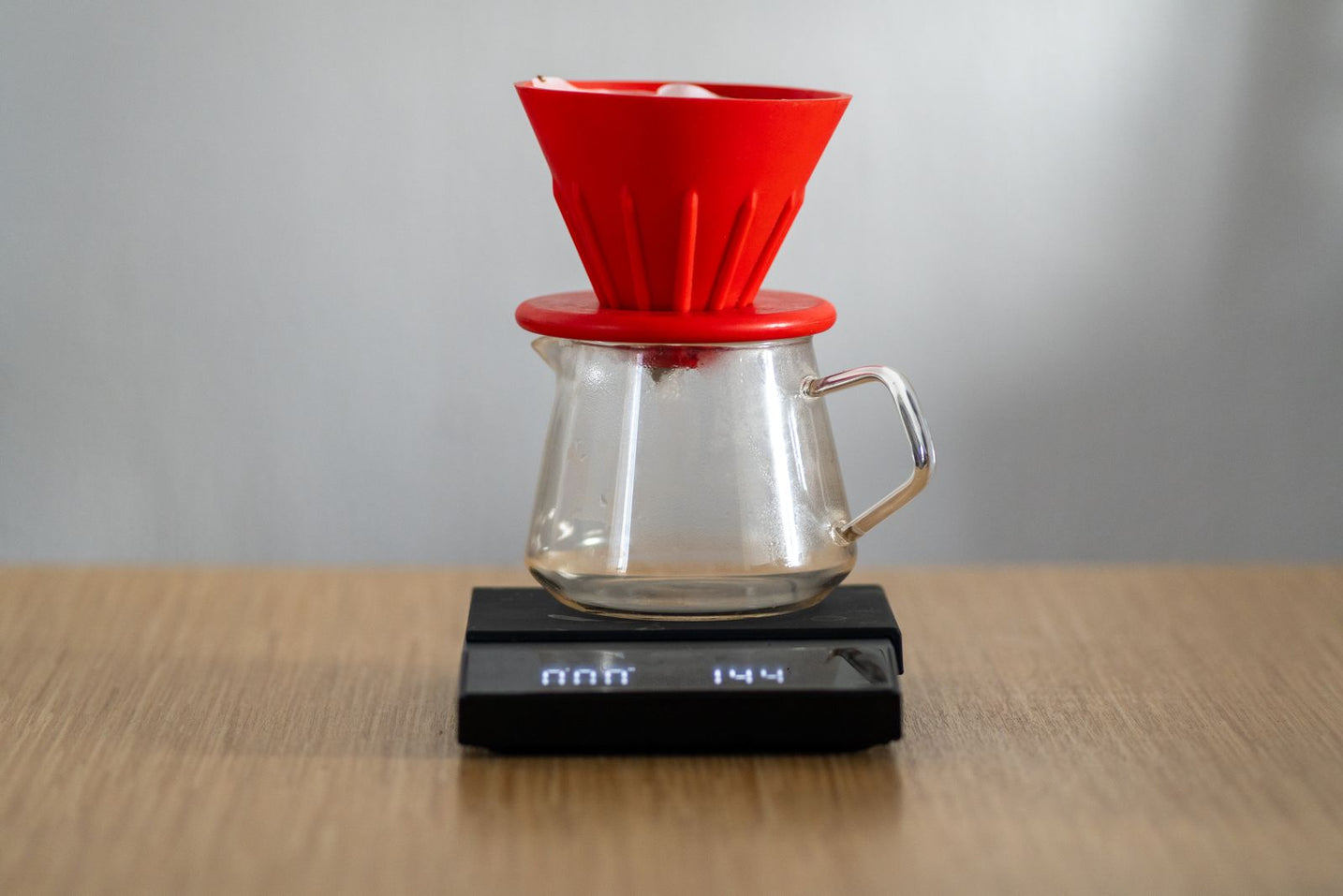
The short answer: 20 grams of coffee, 320 grams of water, two pours. Bloom with 60 grams and swirl, pour to 200 grams by 1:15, pour to 320 grams by 1:45, and the bed should drain dry near 3:00. Grind medium-fine, water just off the boil. Full steps and the fix list are below.
The best V60 tutorials are videos, and videos share a flaw at the counter: your hands are wet, the timer is running, and the part you need is 40 seconds behind the part that is playing. This is the written version. Print it, tape it inside a cabinet door, and stop rewinding.
What is the recipe?
You need a V60 (the plastic one is the right one), a paper filter, a scale with a timer, and a kettle. A gooseneck helps and is not required; there is a variant below without one.
- Prep. Rinse the filter with hot water, dump the rinse water, add 20 grams of medium-fine coffee (close to table salt), and shake the brewer level.
- 0:00, bloom. Start the timer and pour 60 grams of water in slow circles so every ground gets wet. Give the brewer one gentle swirl. Wait.
- 0:45, first pour. Pour in steady circles up to 200 grams total, aiming to land there around 1:15.
- 1:15 to 1:45, second pour. Continue to 320 grams total. Pour a little slower than feels natural.
- Finish. One last gentle swirl to flatten the bed, then let it drain. The bed should look dry and level between 2:45 and 3:15. Total brew ratio: 1:16.
Scaling is arithmetic, and we defended the ratio itself in coffee-to-water ratios without the dogma: one big mug is 15 grams of coffee to 240 grams of water, two cups is 25 to 400. Keep the times the same.
Where does this recipe come from?
Two places, both credited because neither is ours. The bloom-and-swirl backbone comes from James Hoffmann's five-pour V60 method, still the most careful V60 teaching ever filmed. The two-pour structure follows Lance Hedrick's walkthrough of a World Brewers Cup winning recipe, which showed how few pours a great cup needs. What we changed: we collapsed Hoffmann's five pours to two for repeatability, fixed the numbers at counter-friendly values, and wrote it down. Disclosure: Hedrick has commercial relationships with Lotus and Meticulous; neither is sold here and neither changes the physics.
Why do pour height and speed matter?
Because the pour is the agitation. Researchers Park, Young, and Mathijssen at the University of Pennsylvania published "Pour-over coffee: Mixing by a water jet impinging on a granular bed with avalanche dynamics" in Physics of Fluids in 2025. Filming laser-lit pours into transparent particle beds, they found that a steady jet digs into the grounds and sets off small avalanches that recirculate them, and that a taller, unbroken stream mixes the bed harder and extracts more from the same dose.
The practical translation: pour like you mean it. A thin dribble under-mixes; a broken, splashy stream cools and channels. A steady rope of water from a moderate height is the target, and it is why the recipe above says slow circles rather than a hover in the middle.
What is the bloom for?
Roasting fills coffee with carbon dioxide, and the gas leaves slowly over the weeks after roast. Hit dry grounds with hot water and that gas rushes out at once, blowing bubbles that push water away from the coffee. The bloom is a pressure release: 60 grams of water, 45 seconds, and the gas escapes before the pours that matter. Skip it and the first real pour fights a foaming bed, extracting some grounds hard and others barely at all.
The bloom also reads your beans back to you. A bed that rises and bubbles like bread dough is fresh and gassy; if it is a week off roast, expect a touch of sharpness the cup will lose by next weekend, and see our guide to resting coffee for the timing. A bloom that lies flat and quiet means the beans have rested a long while. Neither is a moral failing. The swirl, for its part, is just even wetting: it folds dry pockets into the water without the spoon-stirring that can tear the filter bed.
How do you fix it when it tastes off?
Change one thing per brew. The logic runs on the two dials we mapped in extraction vs. strength.
- Sour, thin, or grassy: under-extracted. Grind one step finer. If the bed drained dry before 2:30, this is almost always the fix.
- Bitter, drying, or hollow: over-extracted. Grind one step coarser, or pour your second pour a little faster.
- Tastes right but weak: extraction is fine, strength is not. Use the same grind and add a gram or two of coffee.
- Intense but harsh: add water to the finished cup. Bypass is a legitimate tool, whatever the internet says.
- Drains past 3:45: grind coarser before blaming your pouring. Stalls are a grind and fines problem before they are a technique problem.
What if you do not have a gooseneck kettle?
Brew anyway. Pour from your regular kettle in shorter, lower passes, close to the slurry, pausing whenever the stream wants to gush. Add one extra swirl after each pour to make up for the lost agitation. The cup gives up a little clarity and keeps every bit of its sweetness, and nobody drinking it will file a complaint.
The shoulders this stands on
- James Hoffmann: the five-pour V60 technique video, the bloom and swirl this recipe is built on.
- Lance Hedrick: the World Brewers Cup recipe walkthrough behind the two-pour structure. Disclosure: Hedrick has ties to Lotus and Meticulous.
- Park, Young, and Mathijssen, University of Pennsylvania: "Pour-over coffee: Mixing by a water jet impinging on a granular bed with avalanche dynamics," Physics of Fluids, 2025.
Questions we hear across the counter
What ratio should I use for a V60?
Start at 1:16, which is 20 grams of coffee to 320 grams of water, and move within 1:15 to 1:17 by taste. The ratio sets strength, not quality; the full argument lives in our ratio guide.
How fine should I grind for V60?
Medium-fine, in the neighborhood of table salt. Numbers vary by grinder, so calibrate with the clock instead: if your bed drains dry well before 2:45, go finer; well after 3:15, go coarser.
What water temperature is best for V60?
Boil the kettle and pour within a minute, which lands you in the mid-90s Celsius. Light roasts like the top of that range. Dark roasts can take water a minute cooler, and both make a better cup than water that sat while you scrolled.
Why does my V60 taste different from the café's?
Bean age and water, in that order. Beans past their peak flatten the cup no matter how well you pour; our storage guide covers keeping them alive. Then check what is in your water, which sets the ceiling on everything else.
Useful brew notes and honest verdicts once a month, written for people who brew before the sun is up: The Small Hours newsletter is free. And a written recipe deserves fresh material: the current bean shelf is here.