
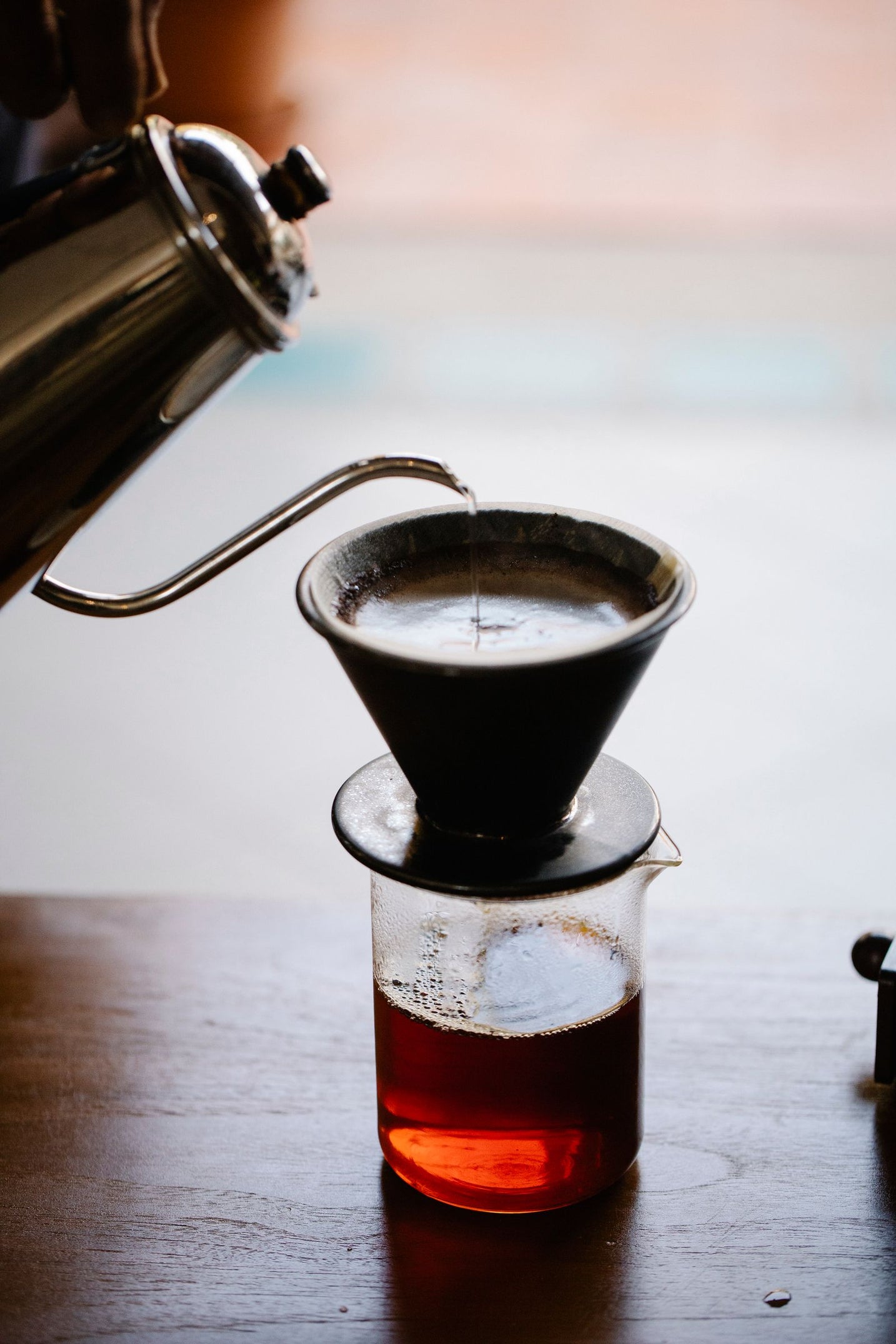
The short answer: start pour over at 1:16, which is 62.5 grams of coffee per liter of water, then move one point at a time until the cup tastes right to you. Weak or strong is a ratio problem. Sour or bitter is a grind problem. The famous golden ratio is only a starting range.
Recipe cards love to present one sacred number. 1:15. 1:16.5. 62.5 grams per liter, no substitutions. Meanwhile the person who wrote each card brews coffee that tastes different from the next card's author, and both of them are happy.
We read the research so you can skip the arguing. The science behind ratios is real, useful, and far less bossy than the recipe cards suggest. Here is what the numbers mean, where the "golden" one came from, and how to find yours in about two brews.
What does a coffee-to-water ratio mean?
A coffee-to-water ratio is the weight of dry coffee compared to the weight of brew water. At 1:16, every gram of coffee meets 16 grams of water. Water weighs one gram per milliliter, so grams and milliliters are interchangeable here. No conversions, no cups-versus-tablespoons confusion.
The math runs in either direction. Pick your coffee dose and multiply, or pick your batch size and divide:
- 1:15 with 20 g of coffee: 300 g of water. Richer, heavier cup.
- 1:16 with 20 g of coffee: 320 g of water. The middle of the road.
- 1:17 with 20 g of coffee: 340 g of water. Lighter body, more clarity.
For batch brewers the same idea reads as grams per liter: 1:16 is 62.5 g of coffee per liter of water. A scale that reads in whole grams is the only gear this requires, and a $25 one does the job. We compared what different scale budgets buy in our scale guide.
Where did the golden ratio for coffee come from?
The number your brewer's manual calls "golden" descends from the 1950s. Ernest Lockhart of the Coffee Brewing Institute surveyed American drip drinkers, mapped their preferences on a chart of strength against extraction, and drew an "ideal" box in the middle. That chart ran the industry for seventy years.
Two quick definitions, because the chart's axes still matter. Strength is how much dissolved coffee sits in your cup, and extraction is what percentage of the grounds dissolved on the way. They move independently, which surprises almost everyone; we unpacked the two dials in Coffee Extraction vs. Strength.
In 2023, a UC Davis Coffee Center team led by Jean-Xavier Guinard, with Scott Frost, Mackenzie Batali, Andrew Cotter, Lik Lim, and William Ristenpart, redrew that chart with trained sensory panels and real consumers (Journal of Food Science, DOI 10.1111/1750-3841.16531). Two findings stand out. First, flavors map predictably: sourness and citrus live at one end of the chart, bitterness and roast at the other. Second, drinkers split into camps. About 57% of their consumers preferred lighter-strength, low-to-medium extraction brews. The other 43% loved either bright, fruity cups or dark, roasty ones, with little enthusiasm for the middle.
Nearly half the panel disagreed with the "ideal" box entirely. The chart works as a map of what different brews taste like. As a verdict on what you should drink, it never had the authority the recipe cards borrowed from it.
What ratio should you use for pour over?
Start at 1:16. It sits in the middle of the range where most pour over recipes live, which makes it the most informative first brew: from there, one taste tells you which direction to walk.
Want more heft and richness? Go 1:15. Want a lighter, tea-like cup that shows off a floral coffee? Go 1:17. Each full point is a noticeable change, so move one point at a time and taste before moving again. Most people settle within two brews and stay there for months.
Our counter advice, offered as opinion rather than physics: fruity light roasts tend to shine around 1:16 to 1:17, and comfort-leaning medium and dark roasts tend to feel right around 1:15 to 1:16. If your taste disagrees, your taste wins. The best cup of coffee is the one you enjoy.
How do you adjust the ratio by taste?
The trick is knowing which complaint belongs to which dial. Ratio controls concentration. Grind controls extraction. Sort your cup's problem into the right bin and the fix is one move:
- Tastes good but weak or watery: tighten the ratio. 1:17 becomes 1:16.
- Tastes good but heavy or muddy: widen the ratio. 1:15 becomes 1:16.
- Tastes sour, sharp, or grassy: leave the ratio alone. That cup is under-extracted, meaning the water dissolved too little of the coffee. Grind finer.
- Tastes bitter, dry, or ashy: also not a ratio problem. That cup is over-extracted. Grind coarser.
Change one thing per brew, or you will never know which change worked. Barista Hustle's Coffee Compass turns this diagnosis into a visual map, and it taught a generation of home brewers to fix cups by taste; we point people to it weekly. Perfect Daily Grind's extraction explainer lands on the same advice we give across the counter: chase the version that tastes best to you, and let the numbers serve the taste.
Do different brew methods need different ratios?
Same math, different starting points. Filtration, contact time, and how strong the drink is meant to be all shift the target:
- Pour over (V60, Kalita, Chemex): 1:15 to 1:17.
- Auto drip: 1:16, or 62.5 g per liter of tank water.
- French press: 1:14 to 1:16. Immersion brewing plus a metal filter makes a heavier cup at the same number.
- AeroPress: anywhere from 1:12 to 1:17 depending on the recipe. It tolerates almost anything.
- Cold brew concentrate: 1:5 to 1:8, then dilute the concentrate to taste.
- Espresso: 1:2 from dry dose to liquid shot weight. Different sport, same weighing habit.
These are the starting points we hand across the counter, not laws. If you brew your press pot at 1:12 and love it, you have lost no points with us. And if you are shopping for a first pour over brewer, the plastic V60 remains the honest pick; we rounded up the owner evidence here.
The shoulders this stands on
- Jean-Xavier Guinard, Scott Frost, Mackenzie Batali, Andrew Cotter, Lik Lim, and William Ristenpart at the UC Davis Coffee Center, whose 2023 study redrew the Brewing Control Chart with real palates: Journal of Food Science, DOI 10.1111/1750-3841.16531.
- Ernest Lockhart and the Coffee Brewing Institute, whose 1950s consumer research produced the original chart the modern study revisits.
- Barista Hustle, for the Coffee Compass, the taste-first diagnostic tool this article's decision list distills.
- Perfect Daily Grind, for the plain-language extraction explainer.
FAQ
What is the golden ratio for coffee?
The phrase usually points to a band around 1:17 to 1:18, inherited from 1950s American drip research. Treat it as a landmark on the map. The 2023 UC Davis study found consumer preferences split into distinct camps, so no single ratio earns the word golden for everyone.
Do I need a scale to use a ratio?
For repeatability, yes. Scoops measure volume, and beans of different roasts and origins pack differently, so the same scoop can swing several grams. A $25 gram scale removes the guesswork; our scale guide covers what more money does and does not buy. That said, if you brew by scoop and love your cup, keep brewing.
Is 1:15 stronger than 1:17?
Yes, all else equal. Less water per gram of coffee means the dissolved coffee is less diluted, so the cup tastes more concentrated. Grind and technique still shape which flavors show up in that stronger cup.
Does roast level change the ratio?
It can. Darker roasts are more brittle and give up their flavor faster, so many drinkers widen the ratio a touch to keep the cup from feeling heavy. That is a preference, and ours is only one vote. Dark roast at 1:15 is a valid breakfast.
Drink the small hours well. For brew experiments and honest verdicts once a month, subscribe to The Small Hours newsletter. And if you need beans worth weighing, our coffee shelf is short on purpose.