
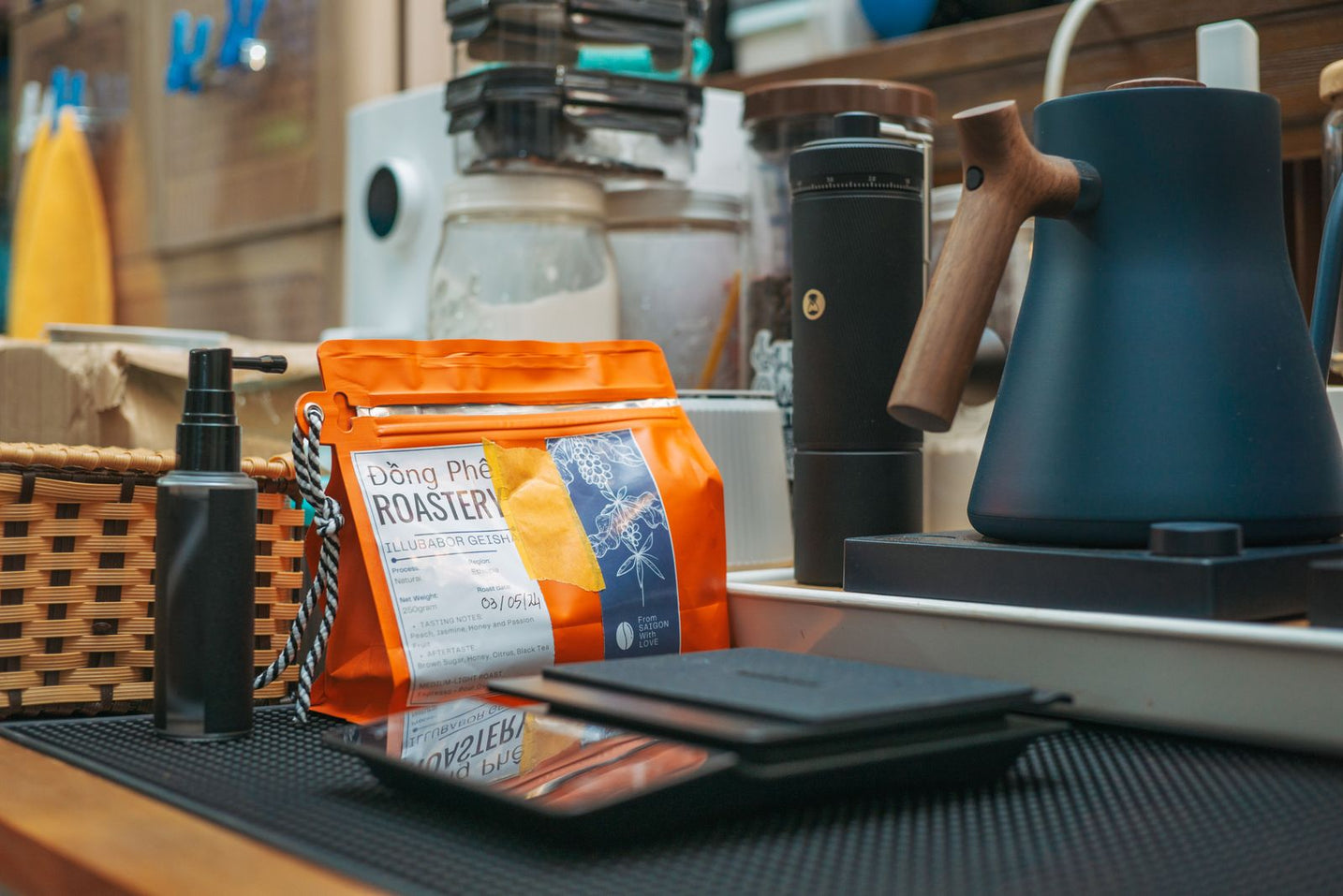
The short answer: keep the recipe fixed at 18 grams in, 36 grams out, and let taste move only the grind. Sour or thin means grind finer. Bitter or harsh means grind coarser. Make one change per shot, halve your moves as you close in, and you can land inside three shots.
Here is the whole protocol, up front:
- Shot one: pull 18 g in, 36 g out at your last bag's grind setting, or the roaster's suggestion if this is bag number one. Note the shot time as a clue, nothing more. Taste it.
- Shot two: make one clear grind move based on that taste. Sour, sharp, or thin: a full step finer. Bitter, drying, or hollow: a full step coarser. Dose and ratio stay put.
- Shot three: half of the previous move in the same direction. If the balance is already right but the cup feels flat, nudge the dose up 1 to 1.5 g instead, a tweak we learned from Jim Schulman.
That is the fix. The rest of this article is the reasoning, the taste map, and what to do on the days three shots does not get you there.
Why does a new bag throw off your espresso?
Because the setting you loved was tuned to the old beans, and beans vary more than machines do. Roast level changes how brittle the bean is, so the same grinder setting produces different particle sizes. Density varies by origin and process. Freshness matters too: roasting traps carbon dioxide in the bean, and that gas escapes over the first days and weeks, a process called degassing that changes how water flows through the puck.
So treat your old grind setting as a guess that worked on different beans. A useful guess, which is why shot one starts there, but the new bag owes it nothing.
What do you set before the first shot?
Three decisions, and two of them are decided for you:
- Dose: fixed. Use what your basket is built for. For most double baskets that is 18 g. Weigh it. A drifting dose makes every other reading meaningless.
- Ratio: fixed at 1:2. 18 g in, 36 g of liquid espresso out, stopped by weight. The 1:2 ratio is the professional starting point, as Tasmin Grant's dialling-in guide for Perfect Daily Grind lays out, and holding it steady is what lets taste point at the grind.
- Grind: your one moving part. Start from the old bag's setting. Moving from a darker bag to a lighter one, start a touch finer; lighter to darker, a touch coarser. That is our counter advice, not physics.
About the clock: a double in the neighborhood of 25 to 30 seconds is common, and PDG's guide treats anything from the low 20s to 40 seconds as normal territory. Use time the way a doctor uses a thermometer. It tells you something changed; it does not tell you what tastes good.
What is shot one telling you?
Everything, if you sort the taste into the right bin. The logic below comes from Jim Schulman's Espresso 101 on Home-Barista, the thread that taught the internet to adjust espresso by taste instead of by stopwatch:
- Sour, sharp, thin, finishes fast: under-extracted, meaning the water left too much flavor behind in the puck. Grind finer.
- Bitter, drying, hollow, tastes like the roast and nothing else: over-extracted. Grind coarser.
- Balanced but bland: the ratio and grind are close. Schulman's move: raise the dose about 1.5 g and coarsen a hair to keep the flow similar. Intensity rises without wrecking the balance.
- Gushed out in 12 seconds, or choked the machine: same logic, bigger move. Two or three steps instead of one.
If you want the full symptom-by-symptom map, including the flavors that fool people, we wrote it up in Espresso Sour or Bitter? Fix Your Shot by Taste.
What do you change on shots two and three?
One variable, and only the grind unless the cup told you otherwise. This is the oldest rule in dialing, repeated by every source we trust: change two things and you learn nothing from the result.
The three-shot speed comes from making your moves like a search, not a stroll. Shot one told you the direction. Shot two makes a full, committed move that way. Shot three halves it. A worked example:
- Shot one: 36 g out in 19 seconds, tastes sour and thin. Verdict: clearly finer.
- Shot two: two steps finer. Now 36 g in 27 seconds, nearly sweet, small sharp edge on the finish. Direction confirmed, magnitude almost right.
- Shot three: one step finer. Sweet, heavy, done. Drink it and stop touching things.
Two habits protect the process. Purge a few grams after each grind change, because the chute still holds grounds at the old setting. And keep notes on the bag: setting, time, one taste word. Thirty seconds of writing saves you a full re-dial when you buy the same coffee again.
James Hoffmann, who did more than anyone to popularize this fixed-recipe, taste-first approach for home baristas, walks through his own version on camera in his How I Dial In Espresso series. Watching someone taste and decide in real time is worth an article's weight on its own.
What if three shots was not enough?
Sometimes the bag wins round one, and it is rarely your fault:
- The coffee is days old from roast. Heavy degassing makes shots erratic from one pull to the next. Give the bag a few days of rest and it will hold still long enough to dial. Our resting guide explains the timing.
- Your grinder's steps are too big. If one step overshoots in both directions, the grinder, and never you, is the limit. Entry grinders make real espresso every day; a stepless or finer-stepped grinder just makes this article's protocol faster. That trade-off is the subject of Upgrade the Grinder First.
- You are on a pressurized basket. The basket regulates flow for you, so shot times move less when the grind changes. The taste logic in this article still applies; the clock just becomes even less useful. Pull what tastes good and enjoy it. This is a judgment-free counter.
And a stopping rule, because dialing can turn into a hobby that eats the hobby: when the cup makes you happy, it is dialed. The last 5% of theoretical sweetness is not worth a week of joyless doubles. The best cup of coffee is the one you enjoy.
The shoulders this stands on
- Jim Schulman, whose Espresso 101 thread on Home-Barista is the origin of the taste-first dose and grind logic here, including the 1.5 g dose tweak.
- James Hoffmann, who popularized fixed-recipe, grind-only dialing for a home audience in his How I Dial In Espresso series.
- Tasmin Grant and Perfect Daily Grind, whose guide to dialling in espresso documents the 1:2 starting ratio and the one-variable rule.
FAQ
How long should an espresso shot take?
There is no deadline to hit. Doubles commonly land near 25 to 30 seconds, and PDG's dialling-in guide treats roughly 22 to 40 seconds as normal territory. Use the time to detect change between shots, then let taste make the call. A delicious 21-second shot beats a harsh 28-second one.
Do I change the dose for every new bag?
No. Keep the dose matched to your basket and let the grind do the work. Reach for a dose change only in Schulman's specific case: the shot is balanced but bland (dose up about 1.5 g) or balanced but overwhelming (dose down the same amount).
How much coffee does dialing in use?
Three doubles is about 54 g, roughly a fifth of a 250 g bag. Budget for it the way you budget for preheating an oven. Weighing every dose and taking notes is what keeps three from becoming ten.
Does this work with dark roasts?
Yes, and dark roast espresso is a classic, not a compromise. Darker beans grind and extract faster, so expect your starting point to sit coarser than it did for a lighter bag. The sour-finer, bitter-coarser logic reads the same in the cup.
Dialing in goes faster when the beans are worth the trouble. Browse the Small Hours coffee shelf, and get useful brew notes and honest verdicts in your inbox once a month from The Small Hours newsletter.