The short answer: if your espresso budget forces a choice, buy the better grinder before the better machine. Grind quality sets the ceiling on every shot; the machine only decides how comfortably you reach that ceiling. The honest upgrade order runs grinder, scale, prep tools, machine, then water, and this guide works the budget math at each step.
Grinder-first is the closest thing home espresso has to a law. It's the advice both the gray-bearded forums and the meme subreddits give in unison, and it's the one piece of received wisdom our own testing keeps confirming. The reasoning deserves better than a chant, so: numbers.
What a grinder controls that a machine can't touch
Espresso is extraction under pressure, and extraction follows particle size. Grind uniformity decides whether the water pulls 20% of each particle evenly or over-extracts the dust while under-extracting the boulders, landing bitter and sour in the same cup. A machine, even a great one, controls water temperature and pressure: the conditions of the extraction. The grinder controls the coffee itself: what there is to extract. Conditions can't fix material. That's the whole asymmetry, and it's why a shot from a $300 machine and a $500 grinder beats the reverse pairing at the same $800 total, morning after morning.
There's a practical asymmetry too. Machines fail loudly (leaks, dead elements) and improve incrementally; a mid-tier machine and a great one hold temperature within a couple degrees of each other. Grinders fail invisibly: an entry burr set doesn't announce that it can't produce the particle distribution light-roast espresso needs. It lets you blame yourself instead. Forum dial-in threads are full of people six months into blaming themselves.
The community reached this verdict long before we did. Home-Barista's perennial "Upgrade Espresso Machine or Grinder?" thread collects two decades of upgraders comparing notes, and the consensus barely wavers: the grinder upgrade is the one people taste. Lance Hedrick's grinder testing on his channel reaches the same conclusion with measurement rather than memory (disclosure: Hedrick has commercial ties in the industry, including Lotus water and the Meticulous machine).
The dead end that proves the rule
The most common stuck-point in home espresso goes like this: shots run sour, so you grind finer, and somewhere right at the edge of espresso range the grinder either stops (out of adjustment) or the shots turn simultaneously sour and harsh (fines from worn or misaligned burrs channeling the puck). No dose, temperature, or technique escapes that trap, because the trap is the particle distribution itself. We wrote the escape routes into the sour espresso guide, and route one is always the same: a grinder with real resolution at the fine end.
What "better" means in a grinder, specifically
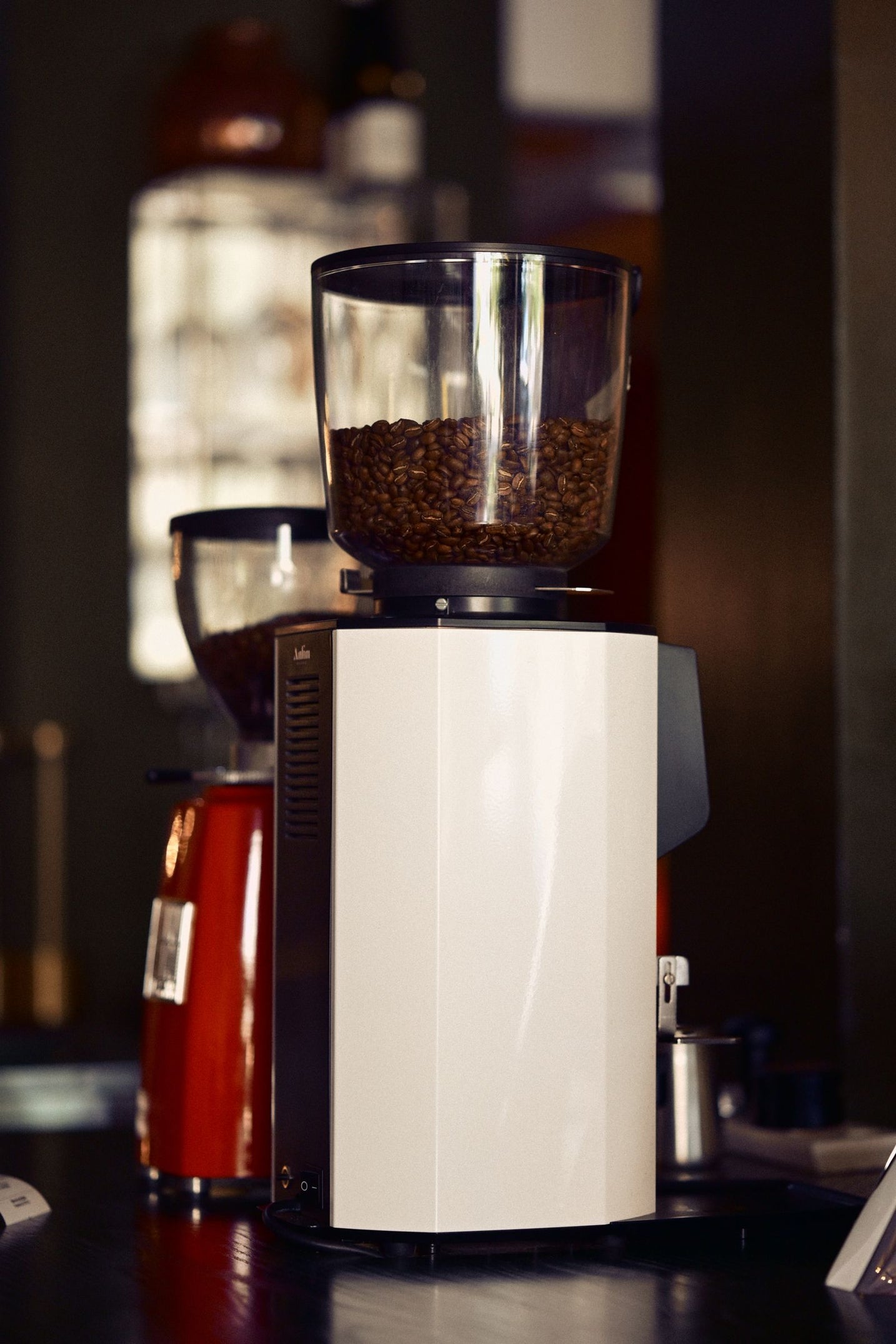
Four things, in order: burrs that cut uniformly at espresso fineness (geometry and machining, not diameter bragging rights), adjustment steps small enough to move a shot 2 or 3 seconds at a time, repeatability (setting 14 today grinds like setting 14 next month), and workflow you'll tolerate at 6 a.m. (retention, mess, noise, or cranking effort). Price tracks these imperfectly. The $299 hand-crank Comandante C40 embarrasses electric grinders at twice its price on the first three and charges you a minute of arm work for the privilege; the Baratza Encore ESP buys genuine espresso capability at $200 by accepting a ceiling; the Fellow Opus is a case study in reading past a spec sheet, a good filter grinder whose espresso claim we called oversold. Which is also the disclosure: we sell grinders, or will, so read all of this skeptically and check our reasoning against the sources.
The budget math, worked
| $800 total, two ways | Machine-first | Grinder-first |
|---|---|---|
| Machine | $600 (nicer panel, same thermoblock idea) | $300 (Bambino-class) |
| Grinder | $200 entry burr | $450 (DF64-class) + $50 tools |
| Where shots land | Stuck at "fine-ish": sour or harsh, hunting settings weekly | Dialed in three shots, repeatable for the rest of the bag |
| The upgrade you'll want in a year | The grinder (the $200 one becomes the bottleneck) | Milk workflow, maybe. Maybe nothing. |
Machine-first buyers upgrade twice. That's the quiet cost the spec sheets never total, and avoiding it is most of what "buy once, cry once" means in this hobby.
What order should espresso upgrades go in?
Grinder first, then in descending order of taste-per-dollar:
- Grinder. The ceiling-setter, for all the reasons above. Entry point around $200 (Encore ESP), sweet spot $300 to $500 (C40, DF64-class).
- A scale. $25 buys repeatability that no other $25 in coffee can. We broke down what scale money buys; the short version is that the cheap one changes your espresso and the expensive one changes your countertop.
- Prep tools. A dosing funnel and a needle distribution tool, together under $20 (the DIY version costs about a dollar). They convert grinder quality into puck quality.
- Machine. Once shots are repeatable and the grinder stops being the bottleneck, machine money buys comfort: faster warmup, steam power, temperature stability for light roasts.
- Water. The stealth upgrade, and sometimes the machine-saver. Our water guide covers when it matters and the cheap ways in.
Skipping steps is allowed; the order is about where each next dollar does the most tasting. The discipline that ties it together is changing one variable at a time, the habit behind the three-shot dial-in.
Where the rule bends
Honesty requires the edge cases. If your machine can't hold a temperature at all, no grinder redeems it; the rule assumes a baseline of "competent," which the current $300 entry class clears. If you drink exclusively traditional dark-roast blends, extraction forgiveness is built into the roast and an entry grinder goes further. And past roughly $700 of grinder for a home bar, the taste returns thin out fast; the four-figure burr chase is a hobby in itself, a fine one, but nobody should mistake it for necessary. The community's other chant applies there: better beans beat better burrs, and a roast-dated bag is the cheapest A/B test in coffee.
Happy to be proved wrong, as ever: hello@drinksmallhours.com.
FAQ
Should I upgrade my espresso machine or my grinder first?
The grinder, in almost every case. The grinder determines what there is to extract; the machine only sets the conditions. Two decades of the Home-Barista upgrade thread and our own testing land on the same answer.
Is a $200 grinder enough for espresso?
Yes, with eyes open. The Baratza Encore ESP class grinds real espresso and dials in medium roasts happily. Its ceiling shows with very light roasts and with the fine-end resolution serious dial-in demands. It is a floor worth standing on, not a trap.
Do hand grinders really compete with electric ones?
At espresso fineness, a good hand grinder outcuts electric grinders at twice its price; the Comandante C40 is the standing example. The cost is a minute of cranking per shot. Your biceps, not the burrs, are the limiting factor.
What should I buy after the grinder?
A scale, then basic prep tools (funnel and needle distributor), then the machine, then water. Each step converts the previous one's quality into the cup more reliably.
The shoulders this stands on
Home-Barista's "Upgrade Espresso Machine or Grinder?" thread, the community's long-running referendum on this question, and the grinder boards where "end game grinder" threads outnumber machine threads for a reason. Lance Hedrick's grinder guides on YouTube (commercial ties disclosed above). espressoaf's entry grinder guide and Honest Coffee Guide's grind-settings work. Budget math and verdicts are our own.
One good email a month: dial-in notes from the bar, gear that survives testing, and honest words about what didn't. Join The Small Hours.