
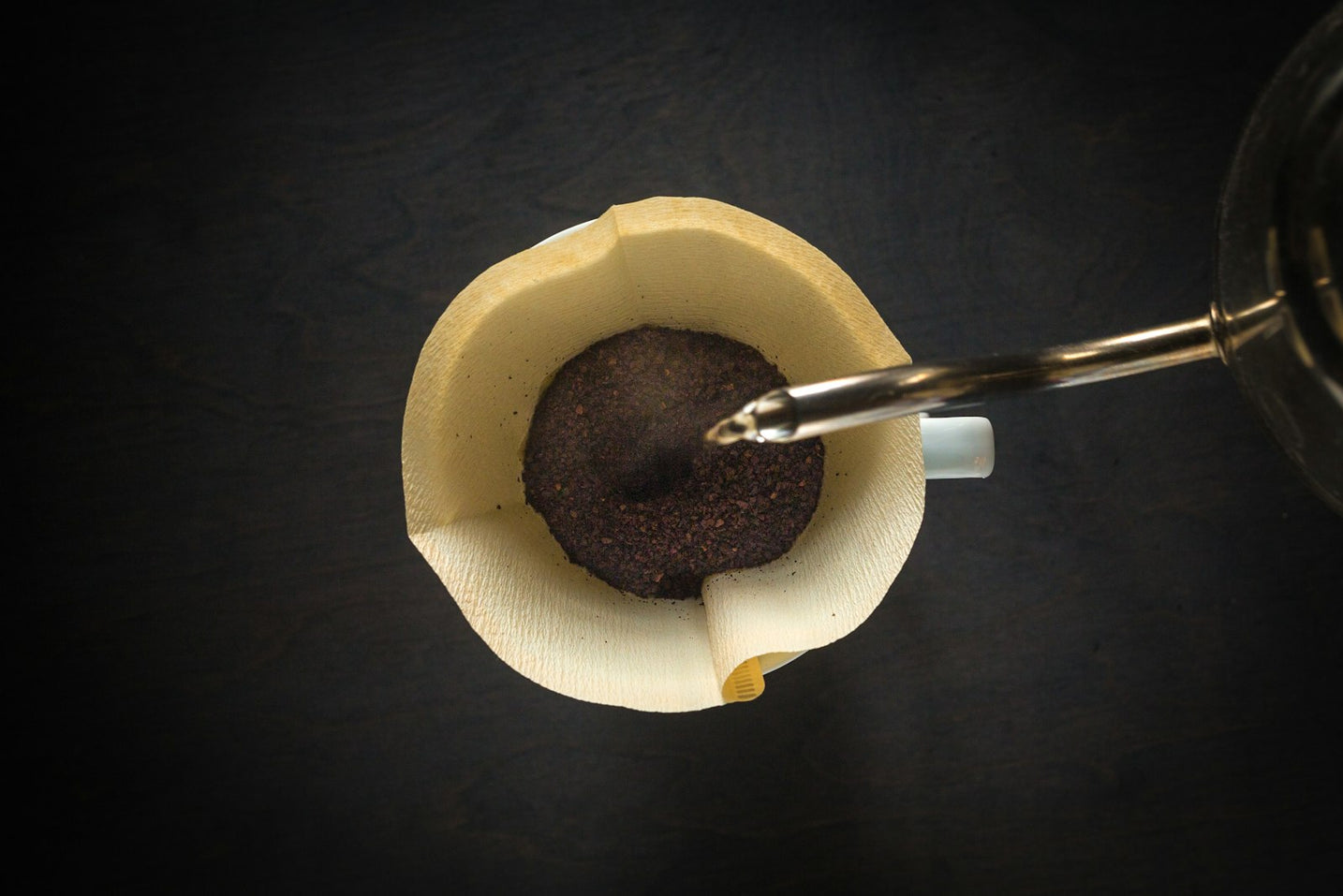
The short answer: once a cup's strength and extraction are held equal, trained tasters could barely tell 87°C coffee from 93°C. Water just off the boil works for almost everything. Temperature changes how fast flavor extracts, so adjust your grind before you touch the kettle dial. What is in your water matters more than how hot it is.
Somewhere along the way, home coffee picked up a superstition: that 93.0°C makes a great cup and 89°C makes a sad one, and that a kettle without a digital readout is holding you back. Second Look is our coffee science series, and this claim earned one, because two research groups have now measured it.
What did the researchers actually test?
The clever part of the UC Davis experiment was separating temperature from its side effects. Hotter water dissolves coffee faster, so a hotter brew usually ends up stronger and more extracted, and tasters notice that. Mackenzie Batali, William Ristenpart, and Jean-Xavier Guinard at the UC Davis Coffee Center brewed drip coffee at 87, 90, and 93°C, then adjusted the recipes so every cup landed at the same strength and extraction. A trained descriptive panel then profiled them blind.
The result sits in the paper's title: "Brew temperature, at fixed brew strength and extraction, has little impact on the sensory profile of drip brew coffee" (Scientific Reports, 2020). Across that six-degree spread, the panels found the cups nearly indistinguishable. The SCA ran a plain-language writeup worth reading. The translation we carry to the counter: temperature is a rate knob, a way of reaching a spot on the strength-and-extraction map faster or slower. It is barely a flavor knob of its own. The map itself lives in our two-dials explainer.
Does the same hold for espresso?
Largely, yes. Benedikt Schmieder and colleagues at the Technical University of Munich measured how flow rate, particle size, and temperature shape espresso extraction kinetics (Foods, 2023). Within the ranges a home machine lives in, grind size and flow moved extraction far more than brew temperature did. Which matches what your machine has been telling you: a shot goes from sour to dialed through the grind setting, and nobody ever rescued one from the temperature menu.
What does temperature still do?
Three real things, so the claim gets its fair hearing.
First, speed. Hotter water extracts faster, so at a fixed brew time, a hotter kettle lands you slightly further along the extraction dial. That makes temperature a legitimate nudge when the grinder has run out of steps: stubborn, dense light roasts take every degree happily, and a very dark roast can take water a minute off the boil to keep the bitter end of extraction at bay. Those are the margins, and they are the same advice we printed in the written V60 recipe.
Second, stability across shots. For espresso machines, holding the same temperature every time matters more than which temperature, because repeatability is what lets you dial anything in. That is a machine-design virtue, and a different claim from "200.5°F or ruin."
Third, the drinking experience. A cup cools as you drink it, and most people notice flavors opening up on the way down. That is perception doing its thing on your tongue, and it is one more reason a half-degree at the kettle was never going to be the difference-maker. That last read is our opinion from the bar, offered as such.
So what should you set the kettle to?
Boil it. Pour within a minute. Light roasts like the top of that window, dark roasts can wait the extra minute, and that is the whole protocol. If the cup tastes off afterward, the fix order runs grind, ratio, water chemistry, and temperature last. Sour means finer, bitter means coarser, and the two dials sort the rest.
One habit does more than any setpoint: preheat what the water touches. Rinse the brewer and filter with hot water, warm the mug, and pour promptly. A cold ceramic cone and a cold mug pull more degrees out of your brew than the difference the UC Davis panel tested, and the fix costs nothing but ten seconds at the sink.
About variable-temperature kettles: we like them, and we say so in our Stagg EKG roundup. Buy one for the gooseneck pour, the hold function, and the pleasure of the thing. Those are real daily benefits. Buy it expecting a flavor transformation and the UC Davis panel has disappointing news. A $20 stovetop kettle with a confident pour makes the same coffee.
When does temperature really change the drink?
At the extremes, where it stops being a nudge and becomes the method. Cold brew swaps heat for time entirely, steeping for many hours, and the chemistry that results is its own subject; our cold brew piece covers what changes and what the acidity myth gets wrong. And water fresh off a rolling boil versus water that sat for ten minutes while you scrolled is a bigger practical gap than 87 versus 93, because the second kettle may have drifted far below any tested range. Pour promptly and the window takes care of itself.
The quiet winner of this whole debate is the water itself. Mineral content decides how well water extracts at any temperature, and if your cup tastes flat or sharp no matter what you do, the water guide is the better use of your attention than the kettle display.
FAQ
What is the best water temperature for brewing coffee?
Anywhere from about 90 to 96°C covers nearly every roast. Boil the kettle and pour within a minute and you are inside that range without measuring. At matched strength and extraction, the UC Davis panel could barely distinguish cups brewed six degrees apart.
Is boiling water too hot for coffee?
No. By the time water leaves the kettle, crosses the air, and meets room-temperature grounds and a rinsed brewer, it has already dropped out of the boil. The "never pour boiling water" rule protects against a problem that largely does not survive the pour. That is bar experience talking, and the sensory data gives it cover.
Do light roasts need hotter water?
They benefit from it more than other roasts, because light roasts are denser and give up their flavor less willingly. Use the kettle at full boil and expect the grind to do most of the work anyway; light roast espresso is its own sport for the same reason.
Do I need a variable temperature kettle?
Need, no. A gooseneck spout and a hold function are honest conveniences that make brewing nicer, and that is the right reason to buy one. The precision readout is the least useful part of the purchase.
The shoulders this stands on
Mackenzie Batali, William Ristenpart, and Jean-Xavier Guinard, UC Davis Coffee Center: "Brew temperature, at fixed brew strength and extraction, has little impact on the sensory profile of drip brew coffee," Scientific Reports, 2020, with the SCA's companion writeup. Benedikt Schmieder and colleagues, Technical University of Munich: "Influence of Flow Rate, Particle Size, and Temperature on Espresso Extraction Kinetics," Foods, 2023. The counter translations and the fix order are our own.
One good email a month: dial-in notes from the bar, gear that survives testing, and honest words about what didn't. Join The Small Hours. And every finding here tastes better with a roast-dated bag.