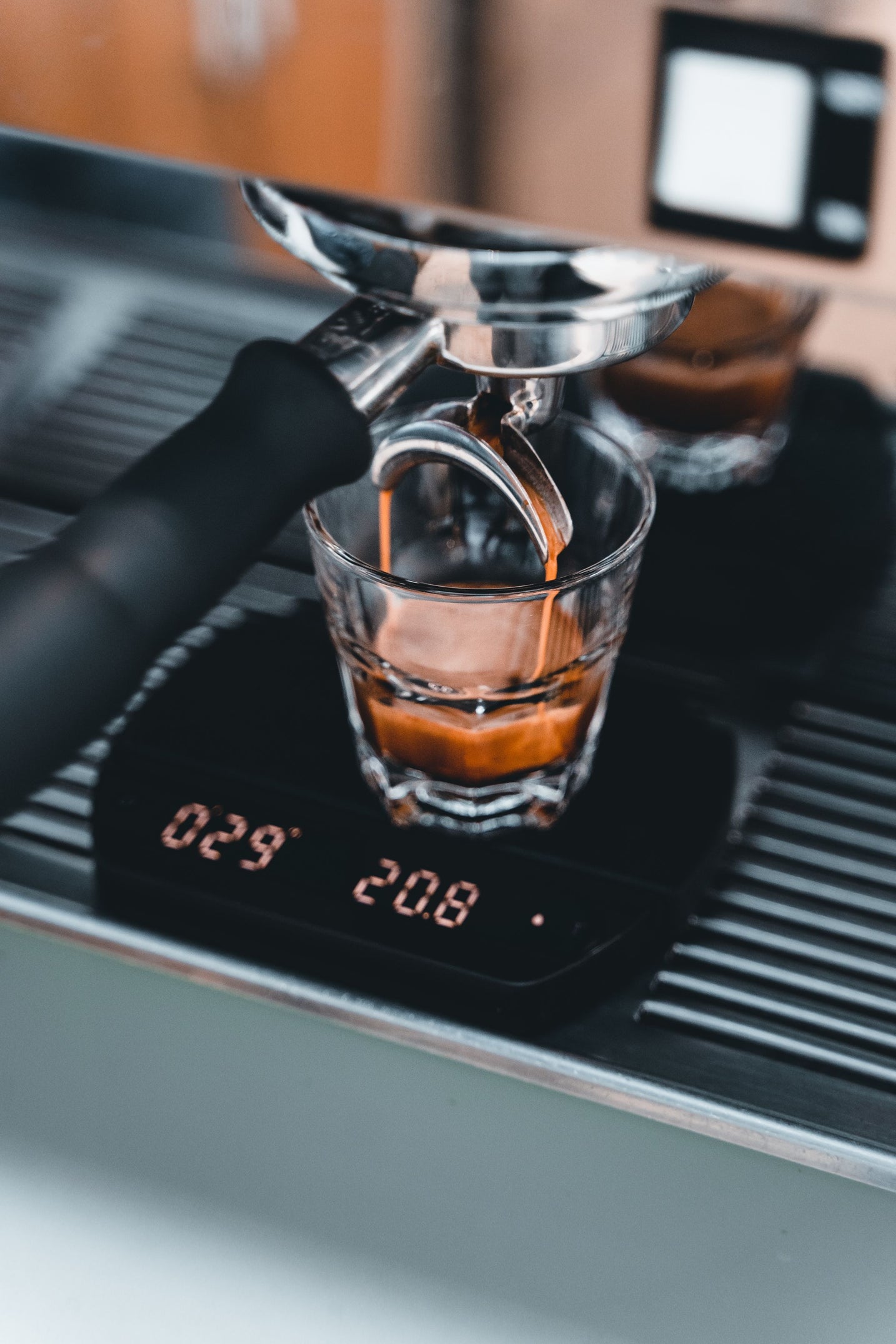
The short answer: a naked portafilter removes the spouts so you can watch the shot form on the basket's underside. A healthy pour starts as drips across the whole basket, gathers into one centered, syrupy cone, and blondes gradually at the end. Jets, blonde patches, and off-center flow each point to a specific prep fault with a specific fix.
What is a naked portafilter, and do I need one?
A naked (or bottomless) portafilter is a standard portafilter with the bottom and spouts machined away, leaving the basket exposed. Nothing about it improves the coffee. Its value is information: the underside of the basket becomes a live map of how evenly water is moving through your puck, which is the thing that decides whether a shot tastes sweet or like a shrug.
Do you need one? No. Spouted portafilters made excellent espresso for a century and still do. A naked portafilter is a $25 to $40 diagnostic instrument, the espresso equivalent of a thermometer. If your shots taste great, you have no fever and need no thermometer. If you are fighting inconsistent shots and cannot see why, twenty seconds of watching will tell you more than a month of guessing.
What does a good pour look like?
Watch for four stages. First, coffee darkens the whole basket underside more or less at once, forming beads across the full circle rather than in one corner. Second, the beads run together and gather toward the center, joining into a single stream within a few seconds. Third, the stream thickens into a smooth, tapering cone the color of dark caramel, flowing like warm honey, sometimes with subtle striping as light and dark currents braid together. Fourth, near the end of the shot, the cone lightens in color evenly, a gradual blonding rather than a sudden switch.
Rough timing helps calibrate your eye. On a classic recipe, the first drips appear 5 to 10 seconds after the pump starts (the puck needs a moment to saturate), the cone forms within another few seconds, and the shot holds that steady state through the middle before blonding at the end. Drips that appear instantly suggest a bed too loose or too coarse; a long dry wait followed by a violent start suggests the opposite. Your phone helps here too: a slow-motion clip of the basket underside catches spritzers and early blonding you will miss with the naked eye, and comparing this week's clip to last week's turns vague impressions into evidence.
That picture is the reference. Every diagnosis below is a departure from it. And one calibration before you start diagnosing: the cup outranks the picture. A slightly imperfect pour that tastes sweet is a good shot. We fix pours in service of taste, using the sour-or-bitter compass as the final word.
What is the spray telling you?
The common faults, what each one means, and where to intervene:
| What you see | What it means | The fix |
|---|---|---|
| A fine jet or spritzer firing sideways | A channel: water found a shortcut through one weak spot in the puck | Stir the grounds with fine needles before tamping (WDT), and check the basket for a knock after locking in |
| One area blondes early while the rest runs dark | Density gradient: that region packed looser and is exhausting first | Distribution again: deep WDT, then a level surface before the tamp |
| Cone forms off-center | Tilted tamp or uneven dosing pushed flow to one side | Level the tamp (elbow over the basket, wrist straight), and settle the grounds flat first |
| Whole shot gushes pale and fast | Grind too coarse for the dose, or a cracked puck from bumping the portafilter | Tighten the grind one step; lock the portafilter in gently and start the pump without delay |
| Machine chokes, then a sudden burst | Bed too tight until a channel blew through it | Coarsen slightly and reduce the dose a half gram; see why finer is not the answer here |
Notice how many rows end in distribution. That is the honest pattern: most visible drama on a naked portafilter traces back to how the dry grounds were arranged before the tamp, which is why the WDT article precedes this one.
What order should I work the fixes in?
One change per shot, cheapest first. Confirm your dose with a scale, since a basket half a gram over its design dose channels near the walls no matter how careful the prep. Stir with thin needles, deep then shallow. Tamp level, with no polishing or double-tapping, since the tamp only needs to seal the bed once. Only after those three are boringly consistent should the grind setting take the blame. This is the same one-variable discipline from the three-shot dial-in, applied to plumbing instead of taste.
Expect improvement in probabilities, not miracles. Good prep turns spritzers from a nightly event into a rare one. Even world-class baristas get the occasional rogue channel; the difference is how rarely.
Which naked portafilter should I buy?
The least glamorous purchase in espresso, which is a compliment. Any bottomless portafilter that fits your machine's group size (58 mm for most prosumer machines, 54 mm for many Brevilles, 51 mm for smaller home machines) does the job, and the $25 generic performs identically to the $150 branded version, because the entire product is an absence. Check the fit for your specific machine, confirm it comes with or accepts a standard basket, and spend nothing more. Pair it with a decent basket and the scale you already own, and you have the complete diagnostic bench. If the sink-side mess worries you: yes, a channeling shot will occasionally redecorate the drip tray. Consider it the fault making itself unmissable, which is the entire service you bought it for.
FAQ
Do I need a naked portafilter to make good espresso?
No. It changes nothing about the extraction; it only lets you watch it. If your shots taste good from a spouted portafilter, you are missing nothing but a light show.
Why does my espresso spray from the portafilter?
A spritzer is a pressurized channel exiting one basket hole: water found a weak path through the puck. The usual causes are clumpy grounds, uneven distribution, or a tilted tamp. Needle distribution before a level tamp resolves most of it.
Is a little spritz ruining my shot?
Not necessarily. A brief spritzer that self-heals costs you a few drops and a little evenness. Taste the shot before performing surgery on your routine. Chronic spraying from the same spot is the version worth chasing.
Will WDT stop channeling completely?
It removes the biggest cause, uneven density, and makes channels rare. It cannot overrule a worn burr set producing extreme fines, a cracked puck, or a soaked, overfilled basket. Fix distribution first, then look upstream.
The shoulders this stands on
The Home-Barista community's Espresso 101, the canonical taste-first adjustment guide, and the forum's long institutional memory of channeling diagnosis, including the WDT Reloaded thread. Barista Hustle's Espresso Compass, which formalized fixing shots by symptom. The pour descriptions and fix ladder come from our own bar's naked-portafilter habit.
Dial-in notes, gear verdicts, and the occasional confession, once a month: The Small Hours newsletter.