
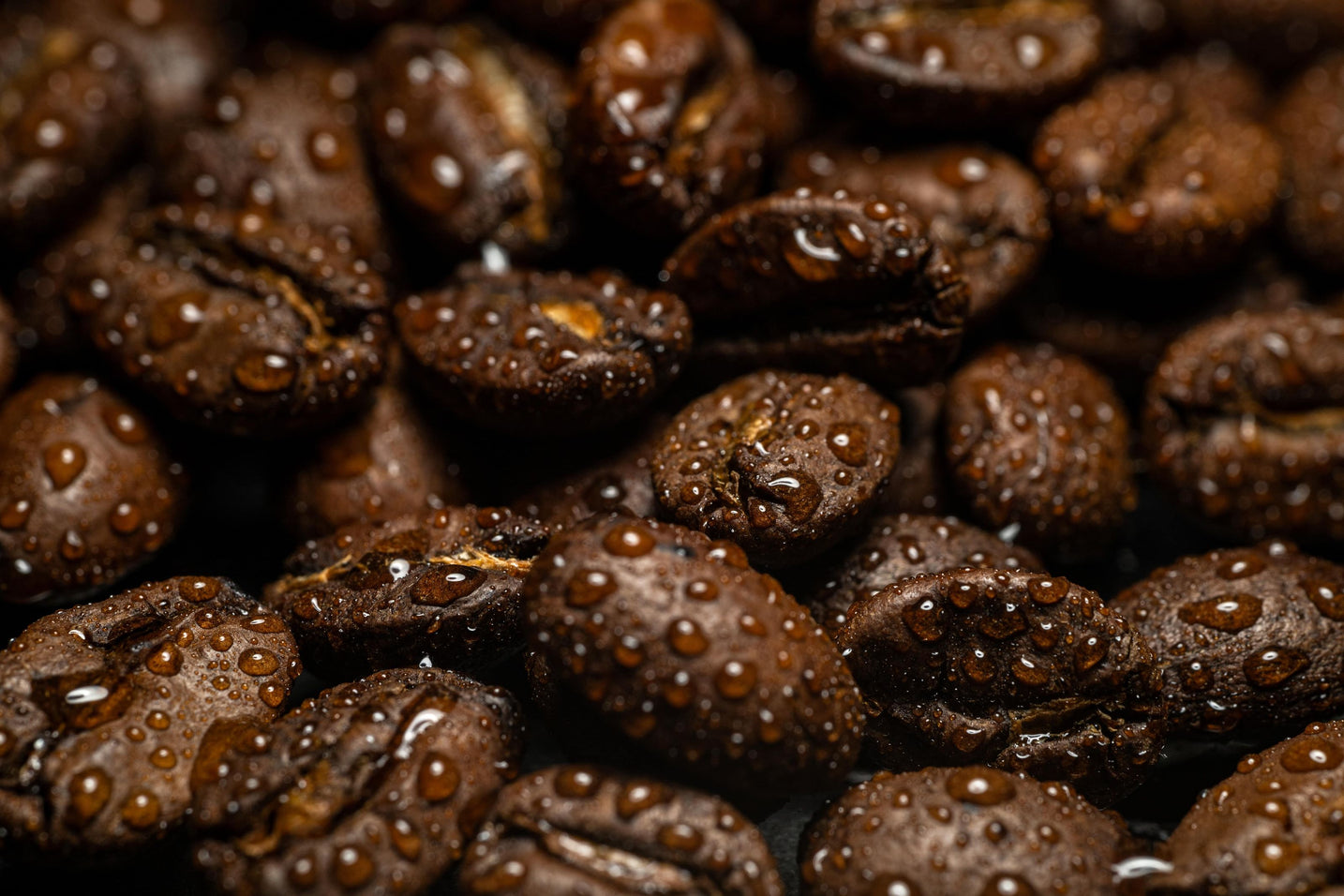
The short answer: put one or two drops of water on your beans and give them a stir before you grind. The static that makes grounds cling to the chute, the bin, and your fingers mostly disappears. Clumps break up, your dose lands where it should, and espresso shots run more consistently. Baristas call it RDT.
The trick costs nothing, takes two seconds, and has a physics paper behind it. Below: where it came from, what the research measured, how much water is enough, and when you can skip the whole thing.
What is the Ross droplet technique?
Grinding rubs coffee against the burrs and against itself, and that friction leaves the particles electrically charged. Physicists call the effect triboelectrification, which is the same reason a balloon sticks to your hair after you rub it there. Charged grounds behave the same way. They leap onto the chute, coat the inside of the bin, and spray a halo of coffee across your counter.
In 2005, a home roaster named David Ross posted a fix on the Usenet group alt.coffee: touch a few drops of water to the beans before grinding. Andy Schecter carried the idea over to the Home-Barista forums, where members tested it, watched their static mess vanish, and named it the Ross Droplet Technique in his honor. Twenty years later the name stuck, and a tiny spray bottle has become standard kit beside many espresso grinders.
For most of those twenty years, RDT was folk wisdom. It worked, and nobody could say precisely why. Then a volcanologist got involved.
What does the science say about grinding with water?
In late 2023, Joshua Méndez Harper of Portland State University and Christopher Hendon of the University of Oregon published "Moisture-controlled triboelectrification during coffee grinding" in the journal Matter. Méndez Harper studies volcanic lightning, which turns out to be the same physics at a less caffeinated scale: fracturing particles build charge. The team ground a range of coffees and measured the electricity coming off them.
Three findings matter for your kitchen. First, moisture inside the bean controls the charge: coffees with higher internal moisture generated less static, and drier, darker roasts generated more. Second, adding a little water before grinding cut the static and the clumping that comes with it. Third, and this is the surprising part, the water changed the espresso itself. Shots pulled from water-treated grounds ran longer, came out stronger (the authors point to concentration gains in the range of 10 to 15 percent), and varied less from shot to shot.
Why would static affect taste? Clumps. Charged fines stick together into little clusters that water cannot penetrate evenly, so parts of the puck over-extract while the inside of each clump barely brews. Kill the static and the grounds settle loose and even. If you have read our piece on why grinding finer can make espresso worse, this is the same lab, and the same theme: evenness beats intensity. One caveat they are upfront about: the team only tested espresso. The mess reduction applies everywhere, but the extraction gains are an espresso result so far.
There is also a quiet freshness angle here. Beans lose internal moisture as they age, and internal moisture is what keeps static down before you add a single drop. A recently roasted bag starts you ahead of the game.
How much water is a spritz?
One or two drops for an 18 to 20 gram espresso dose. That is the whole recipe. Dip a clean fingertip in water and flick it over the beans (the original Ross method), or hold a small spray bottle a hand's width above your dosing cup and give it one pump. Stir the beans for a second or shake the cup so the moisture spreads, then grind right away.
Our counter rule: drops, not pours. This is the verdict we would give you across the bar. More water buys you nothing, and visibly wet beans can cake in the chute and leave damp grounds sitting in the grinder. Burrs are steel; standing moisture is not their friend. A spritz that light evaporates or passes through with the coffee, but it is still worth wiping out your grinds path once in a while, which you should be doing anyway. Our guide to dialing in a new bag assumes a clean, consistent grinder, and this habit protects that.
Do you need RDT for pour over or drip?
Probably not, and that is fine. In our experience the static problem is worst with fine espresso grinds, single-dose grinders, and dry winter air. Coarser filter grinds carry the charge less dramatically, so if your morning drip routine leaves no mess, there is no problem for this trick to solve. A ritual that fixes nothing is just a ritual.
If your filter grinder does spray grounds everywhere, RDT works the same way it does for espresso, and the mess reduction alone earns its two seconds. Just scale the dose: two or three drops for a 30 gram brew dose still counts as barely damp.
When should you skip it?
Skip it if your grinder already manages static well; several current models build in ionizers or metal grounds paths that do the job. Skip it if you live somewhere humid, because ambient moisture is doing the work for free. And check your manual first: a few manufacturers warn against introducing moisture anywhere near the burr chamber, and on warranty questions the manual outranks a forum post. When in doubt, ask the maker.
Nobody needs RDT to make coffee they love. It is a two-second fix for two specific problems, mess and clumping, and if you do not have those problems, your routine is already right.
FAQ: grinding with water
Will a few drops of water damage my grinder?
Drops on beans that you grind immediately pass through the burrs in seconds along with the coffee, and the measured moisture involved is tiny. The risks come from overdoing it: spraying into the burr chamber itself, or leaving damp grounds sitting in the machine. Keep the water on the beans, keep the amount to drops, and follow your manufacturer's guidance if it says otherwise.
Does RDT change how espresso tastes?
Indirectly. The water does not add flavor; at one or two drops against a 36 gram shot, it is a rounding error. What changes is evenness. The Méndez Harper and Hendon study measured stronger, more repeatable shots from water-treated grounds, which they attribute to less clumping and a more uniformly packed puck. Many people read that as "smoother." What you will notice most is that the same recipe behaves the same way twice.
Is RDT the same as WDT?
No, and they stack nicely. RDT happens before grinding and fights static. WDT happens after grinding and breaks up clumps by stirring the grounds in the portafilter with fine needles. RDT means WDT has less work to do, but plenty of careful espresso routines use both.
Do I need a special spray bottle?
No. A fingertip and a cup of water work exactly as well as they did for David Ross in 2005. Small spray bottles are a convenience, not equipment. If a $4 bottle makes the habit stick, buy the bottle; if not, your finger is free.
The shoulders this stands on
This piece distills other people's work, and they deserve the credit. David Ross described the original trick on alt.coffee in 2005, and Andy Schecter brought it to the Home-Barista community, which named and spread it. The science comes from Joshua Méndez Harper (Portland State University), Christopher Hendon (University of Oregon), and their coauthors in "Moisture-controlled triboelectrification during coffee grinding," Matter, 2024. Our contribution is the counter-level translation: drops, not pours, and only if you have the problem.
The Small Hours is our newsletter: one short letter each month on making better coffee without buying more stuff. Join us here.